

Astronomy Object of the Month: 2026, July
< previous Archive next >
Life after life of radio galaxies – the repeated death and resumption of activity of supermassive black holes
Among the several million radio galaxies discovered to date, astronomers have recently identified several peculiar classes that deviate from the classical view of these objects.
Studying unusual giant double-double radio galaxies is helping astronomers understand the nature of active supermassive black holes located at the centers of some galaxies.
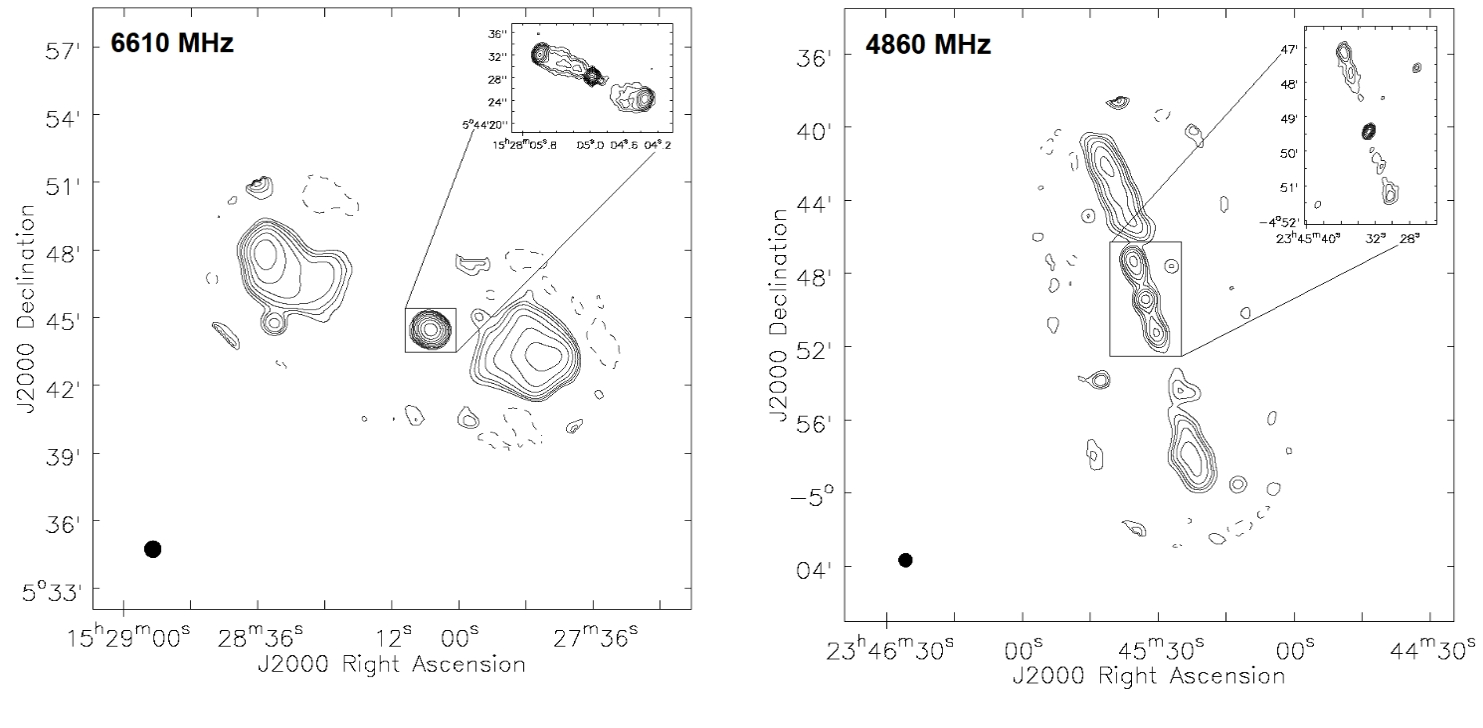
Illustration 1: Radio maps obtained with the use of the Very Large Array Interferometer (USA) of the two analyzed double-double radio galaxies, with magnification of their central structures in the upper right corner and beam profile (angular resolution) marked in the lower left corner. Left panel: radio contours of J1528+0544 at 6.6 GHz. Right panel: radio contours of J2345-0449 at 4.9 GHz (The Authors).
Objects called radio galaxies have been known to astronomers since the 1950s. The widely accepted mechanism for their formation involves a rotating supermassive black hole (SMBH) surrounded by a disk of accreting material. From these relatively small objects, called active galactic nuclei (AGN), matter, energy, and magnetic fields can be transferred in the form of narrow relativistic outflows (jets) of charged plasma over very large distances, far exceeding the size of the galaxy. A typical radio galaxy is Cygnus A.
Classical radio galaxies and their compact counterparts with jets visible at small angles to the viewing angle have already been studied in considerable detail. Interestingly, recent sky surveys (e.g. LoTSS DR3) also reveal a significant number of rare and peculiar objects that were previously poorly understood or even completely unknown. These include, among others, so-called double-double radio galaxies (DDRG) with recurring central AGN activity.
DDRGs are objects with more than one pair of lobes generated by the same AGN and oriented along the same line. These objects are rare -- about 100 are currently known. They range in size from hundreds of kiloparsecs to several megaparsecs. Gaps in jet formation may be caused by interruptions in the accretion of matter onto the central AGN and/or instabilities in the accretion disk. Some researchers suggest that this type of radio galaxy may form through interactions between binary SMBHs and the accretion disk. Others have recently proposed a different scenario, in which, despite continuous accretion onto the SMBH, a jet cannot form because the SMBH spin drops to zero. This can occur when the accretion disk changes direction from counter-rotating (relative to the SMBH) to co-rotating. In the case of DDRGs, one of the most important factors is determining the age of their radio structures. Unfortunately, so far, the age has only been determined for a small number of objects because the research method is based on multi-frequency radio data, which is time-consuming to obtain.
Radio astronomers from Astronomical Observatory of the Jagiellonian University have been studying DDRGs for many years and determining their physical parameters, including the ages of their young and old lobes and the duration of the dormant periods of the central AGN. Their recent research was published late last year in the journal Astronomy and Astrophysics. The researchers studied three giant radio galaxies: J1021+1216, J1528+0544, and J2345-0449 (maps of the latter two are shown in Illustration 1). In addition to determining the timescales (see Illustration 2) mentioned above, they also concluded that the inner lobes of J1021+1216 are expanding at close to half the speed of light within old lobes with a very low density of 10-25.7 kg/m3. In two of the studied objects, i.e. J1021+1216 and J1528+0544, an additional, third phase of activity was discovered – only a few such objects are known.
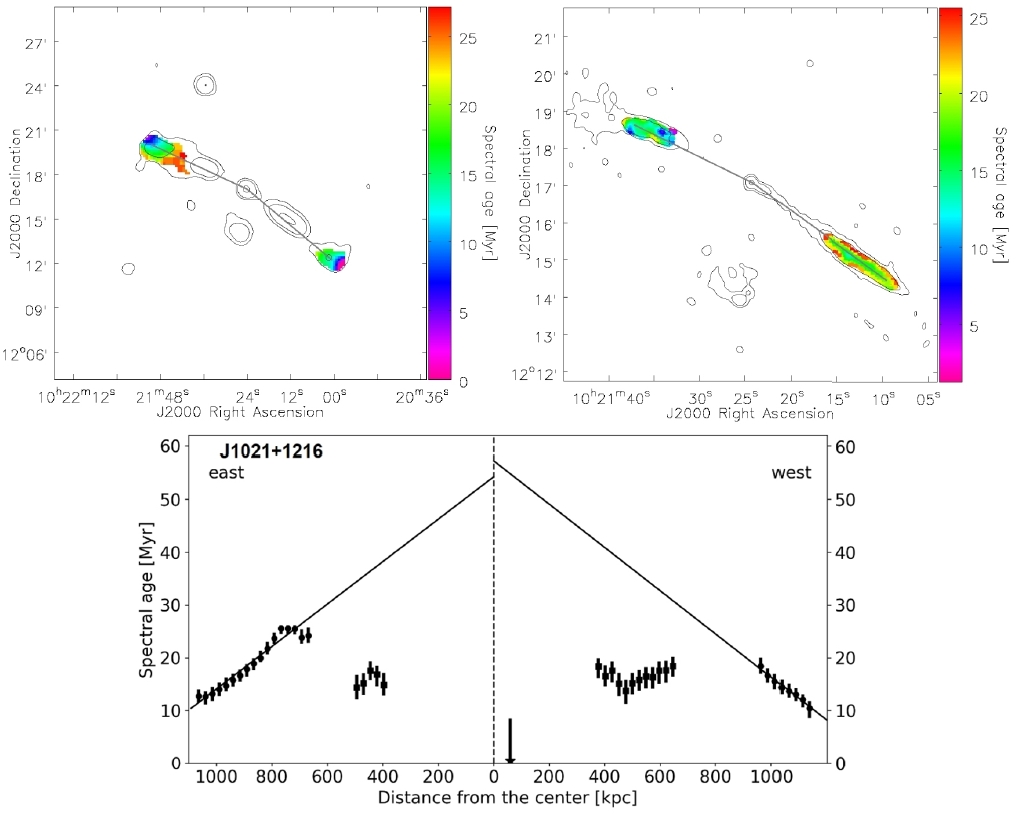
Illustration 2: Upper panel: Spectral age maps of the DDRG J1021+1216. The line marks a cross-section through the source. Upper left panel: Spectral age of the outer double. Upper right panel: Spectral age of the inner double. Lower panel: Spectral age profile of J1021+ 1216 performed along the cross-section marked in the upper-level figures. Solid lines indicate the best-fit velocity growth of the old lobes (The Authors).
Original publications: Wolnik, K., Jamrozy, M., Multifrequency study of three giant radio galaxies with recurrent jet-formation activity: J1021+1216, J1528+0544, and J2345−0449: I. Radio observations, Astronomy & Astrophysics, 704, 284 (2025); Wolnik, K., Jamrozy, M., Multifrequency study of three giant radio galaxies with recurrent jet-formation activity: J1021+1216, J1528+0544, and J2345─0449: II. Spectral aging analysis and dynamical modeling , Astronomy & Astrophysics, 704, 285 (2025).
The research was conducted at the Department of Stellar and Extragalactic Astronomy of the Jagiellonian University’s Astronomical Observatory of the Jagiellonian University in Kraków. The work was carried out thanks to the financial support of the National Science Center through grant UMO-2018/29/B/ST9/01793.
|
Kamil Wolnik Astronomical Observatory Jagiellonian University Kamil Wolnik [at] doctoral.uj.edu.pl |
Marek Jamrozy Astronomical Observatory Jagiellonian University Marek.Jamrozy [at] uj.edu.pl |
