

Astronomy Object of the Month: 2026, February
< previous Archive next >
The most complete radio map of the Universe: LOFAR LoTSS-DR3
International team of astronomers, including researchers from Poland, published the most detailed radio survey of the sky in the history. The
LoTSS-DR3 project, carried out using the pan-European LOFAR radio telescope array, made it possible to catalogue no less than 13.7 million
active galaxies.
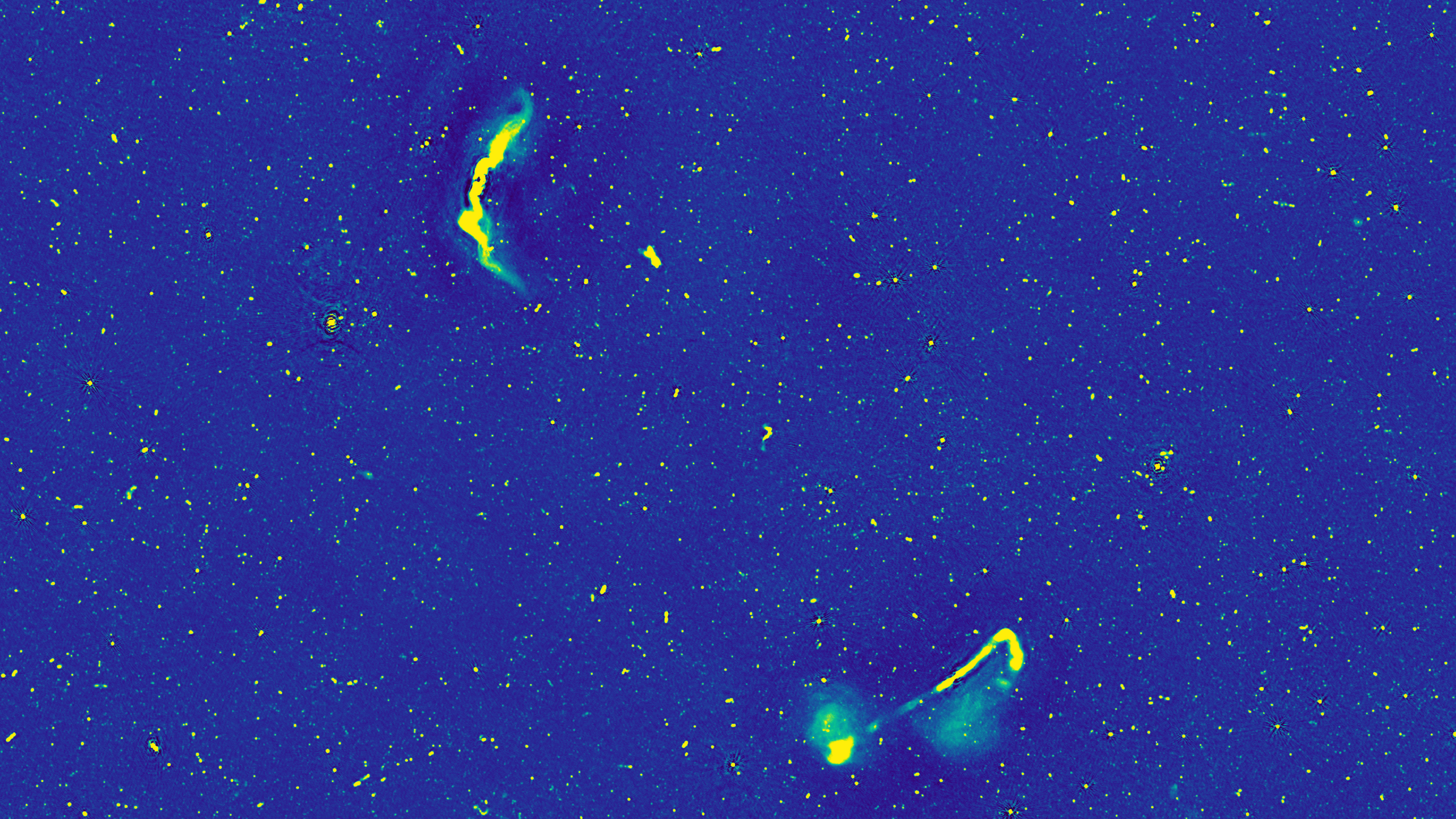
Illustration (1): Radio galaxies NGC 315 and NGC 383 dominate this LoTSS DR3 survey map with their spectacular and twisted jets powered by central supermassive black holes. These radio galaxies are located at a distance of about 223 and 209 million light-years from Earth and stand out against hundreds of much more distant radio galaxies, visible here as faint emission points (LOFAR surveys collaboration).
Low-frequency radio sky observations provide a completely different picture of the Universe than that visible in the light visible to our eyes. They allow astronomers to track highly energetic phenomena, such as the turbulent star formation processes occurring in galaxies at different cosmological epochs. The deepest radio maps of the Universe ever made are opening up many new areas of analysis, giving us valuable insights into the formation and evolution of cosmic structures, the acceleration of particles to extreme energies, and the configuration of cosmic magnetic fields.
LOw Frequency ARray (LOFAR) is a revolutionary radio telescope designed and built by the Netherlands Institute for Radio Astronomy (ASTRON) and managed by the LOFAR European Research Infrastructure Consortium (LOFAR ERIC), which brings together institutions from eight countries, including Poland. Unlike traditional parabolic antennas, LOFAR consists of thousands of simple elements – dipoles located throughout Europe, connected by fiber optic networks. Data from all antennas are combined using powerful computers to create radio images of the sky. There are three LOFAR stations in Poland: in Borówiec near Poznań (Space Research Center), Bałdy near Olsztyn (University of Warmia and Mazury), and in Łazy near Bochnia, belonging to the Jagiellonian University in Cracow.
The success of the new survey is the result of over a decade of hard work and processing a huge amount of data (over 18 petabytes, which took 20 million hours of processor time to complete). In order to obtain clear images of the radio sky, scientists had to develop innovative algorithms to eliminate interference caused by, among others, Earth's ionosphere.
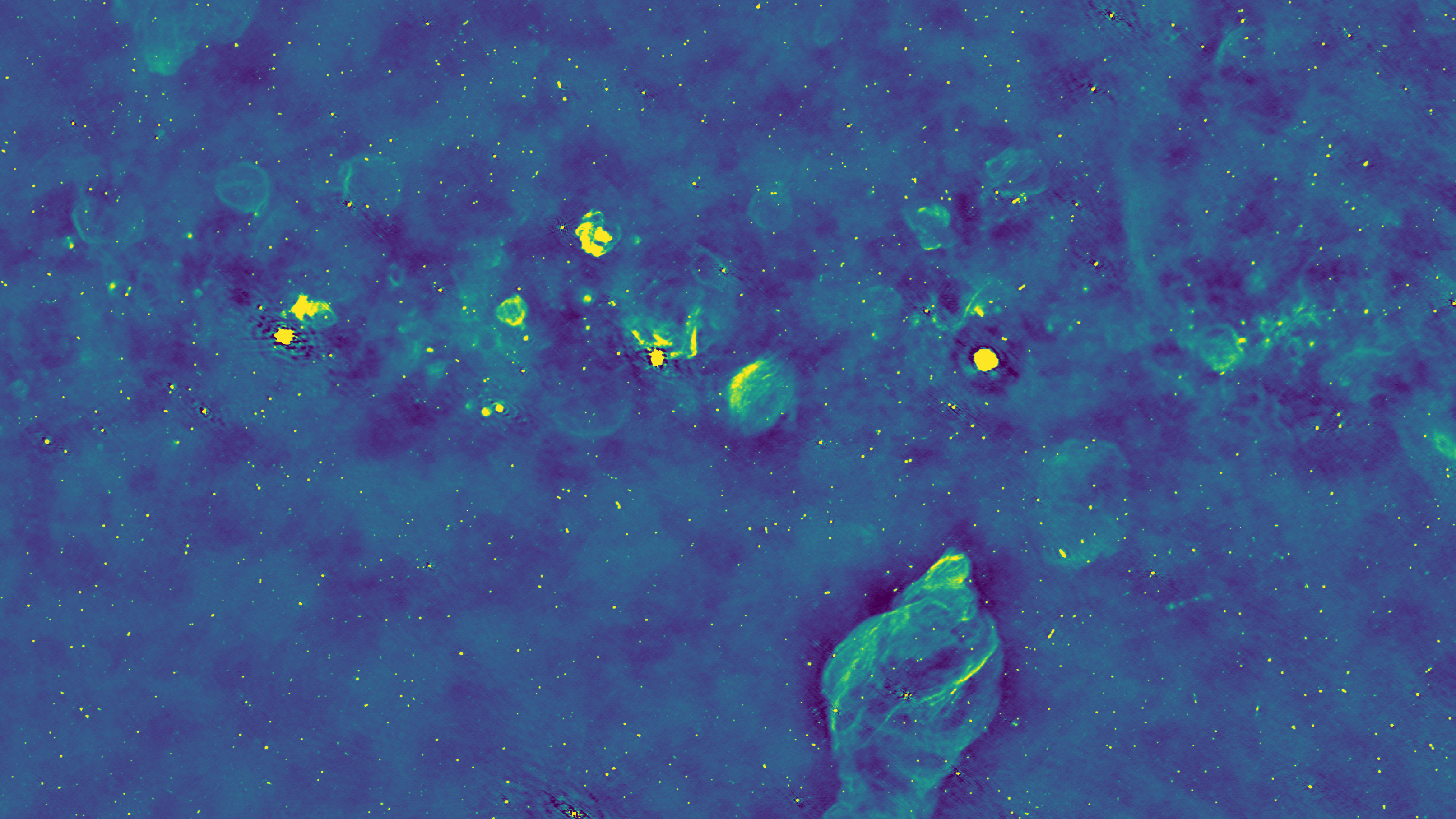
Illustration (2): Here, LOFAR looks into our Galaxy toward the constellation Aquila, where many massive stars have exploded. The large Manatee Nebula (lower right) and many other bubble-like supernova remnants are visible in the image. Beyond these is a background of distant radio galaxies seen as faint points. (LOFAR surveys collaboration).
Illustration (3): The LOFAR sky from the Andromeda Galaxy (M31) to NGC 315 and NGC 383. This image spans part of the constellations of Andromeda and Pisces, covering about 15 degrees square – roughly the span of an outstretched hand at arm's length. Credit: LOFAR surveys collaboration.
The article summarizing the review has been published in the journal Astronomy & Astrophysics. The researchers involved in the LoTSS-DR3 project include academics from the Netherlands, Germany, France, Great Britain, Italy, Sweden, Ireland, Latvia, and Bulgaria, as well as numerous astronomers from Polish institutions: Jagiellonian University, National Center for Nuclear Research, the University of Warmia and Mazury, the Center for Theoretical Physics of the Polish Academy of Sciences, and the Nicolaus Copernicus University in Toruń. The Jagiellonian University Astronomical Observatory is represented by Professor Krzysztof Chyży, Professor Marek Jamrozy, Dr. Arpita Misra, and Dr. Sagar Sethi.`
Read more
Original publication: T.W. Shimwell, M. J. Hardcastle, C. Tasse et al., The LOFAR Two-metre Sky Survey VII. Third Data Release, Astronomy & Astrophysics (2026).
The research described is part of the research topics conducted at the Department of Radioastronomy and Space Physics of the Astronomical Observatory of the Jagiellonian University in Kraków.
|
Marek Jamrozy Astronomical Observatory Jagiellonian University M.Jamrozy [at] oa.uj.edu.pl |
