

Astronomy Object of the Month: 2026, August
< previous Archive next >
Black holes consuming stars
Astronomers analyzed a sample of galaxies that suddenly “turned on” their radio emissions. In most cases, this means that their supermassive black hole began accreting matter more intensely and triggered a faint jet, but a few objects behave differently. Their galaxies are actively forming stars, the black holes are smaller, infrared flares appear, and the pattern of changes in radio emissions resembles known cases of a star being consumed by a black hole. The authors of this article suggest that some radio transient phenomena may in fact be cases of a star being torn apart and swallowed by a supermassive black hole, and that the WISE W3–radio ratio may prove to be a new way to distinguish them.
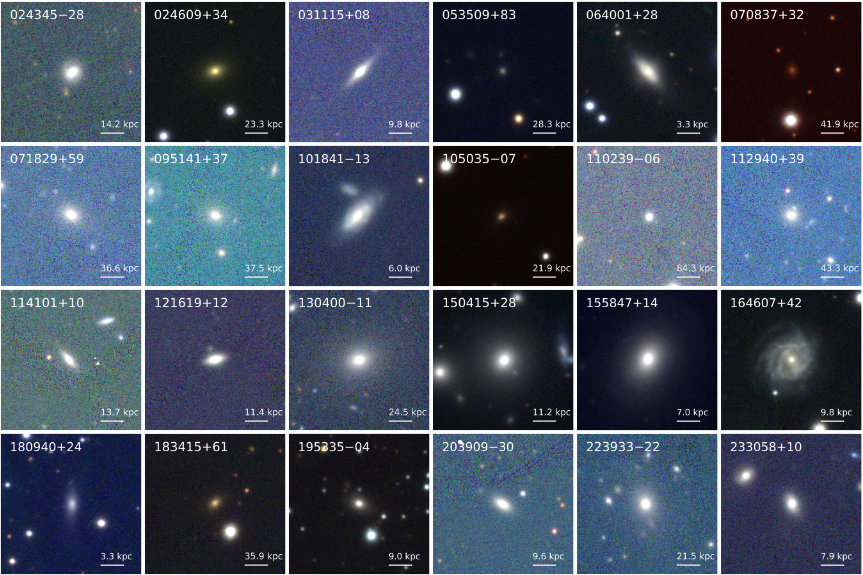
Illustration 1: Examples of Pan-STARRS survey images for the sample being studied. The observed source is located in the center of each image. The scale is 10' (The Authors).
What is a tidal disruption event (TDE)? Imagine a star passing very close to a supermassive black hole. The difference in gravitational forces acting on the closer and farther parts of the star becomes so great that the star is torn apart. Some of its matter then begins to fall into the black hole, creating a short-lived episode of very intense accretion. We primarily associate TDEs with sudden changes in brightness in the optical, ultraviolet, or X-ray bands. It turns out, however, that some TDEs also produce radio emissions. These may originate from a relativistic jet, a non-relativistic outflow of matter, or a shock wave formed when the ejected matter interacts with its surroundings.
The problem with identifying TDEs using radio data comes from the fact that radio variability can also result from the usual variability of AGNs. This raises the fundamental question: Is a transient brightening in radio waves the result of a temporary activation of an active galactic nucleus (AGN), or is it a sign of a star being disrupted by a black hole? Recently, astronomers analyzed 24 objects in which radio emission appeared only recently—so-called radio transients. Instead of focusing only on radio emissions, however, they studied these objects across multiple ranges of the electromagnetic spectrum. They used new optical data from the Palomar and Keck telescopes, archival spectra from the SDSS survey, optical photometry, WISE data, long-term optical monitoring, and multi-epoch radio observations. This allowed them to answer the question of what lies within a galaxy that has suddenly become a source of radio emission.
What has been found? This is a very interesting result, because the sample under study is not homogeneous. Most of these sources are located in massive elliptical galaxies, dominated by old stellar populations. In many cases, the spectra point to Seyfert galaxies, LINERs, or faint AGNs. Importantly, the black holes in these objects are often very massive, with masses exceeding 10⁸ MSun in more than half of the sample. This fits very well with the interpretation that radio transients represent a sudden activation or change in the accretion rate of the AGN.
However, there is another group of sources. A few objects behave quite differently. Their galaxies show clear signs of active star formation; they are not typical old elliptical galaxies, and their central black holes have significantly lower masses. This is important because TDEs are more likely to occur around black holes with masses below about 10⁸ MSun. For a very massive, non-rotating black hole, a star can be swallowed before it is torn apart by tidal forces, so a TDE does not occur. In the sample studied, some of the objects have black hole masses in the range of 10⁶–10⁷ MSun, which is precisely the range of particular interest in terms of TDEs. The sample also included two objects that, in addition to radio variability, exhibit infrared flares. This is interesting because the infrared brightening may be related to the fact that dust in the surrounding environment absorbs the initial TDE radiation and then re-emits the energy in the infrared. This is known as an infrared echo. Schematically, this can be represented as a sequence of events: TDE – a strong UV/X-ray flare – radiation reaches the dust – the dust absorbs energy and heats up – IR emission occurs. This behavior is characteristic of some known TDE sources.
The authors also used WISE data to determine whether the studied objects resemble AGN-hosting galaxies, star-forming galaxies, quasars, or other known cases of TDEs. On the WISE color-color diagram, the TDEs do not fall exactly at a single point, but most are located in the region associated with the population of star-forming galaxies. In contrast, most of the typical radio transients in the sample are closer to the population of standard radio galaxies/AGNs. This is the first indication that the galactic environment may help distinguish TDEs from ordinary radio variability in AGNs.
The authors took it a step further, comparing brightness in the WISE W3 band with radio flux—not just looking at a single point in time, but at the evolution of a given source over time. This is important. Two objects may have similar radio brightness today, but if we trace their history, they may move across the W3–radio diagram in completely different ways. The evolution of TDE candidates on this diagram is similar to that of known TDEs initially detected in the optical band, which later began emitting radio waves. In contrast, the remaining radio transients behave more like variable AGNs. And this is precisely what led the authors to propose that the W3–radio relationship could, in the future, become a diagnostic tool for distinguishing TDE radio activity from AGN variability.
These results show that not every sudden burst of radio activity marks the beginning of the classic radio-loud AGN phase. We may be observing a very short episode: accretion—jet—radio emission—fading. Thus, we are likely observing brief episodes of black hole activity that may be difficult to detect in classical surveys, which is particularly interesting in the context of AGN evolution. Instead of the familiar pattern: AGN OFF – AGN ON, we see rather: On – Off – On – Off – …, that is, episodic, intermittent activity. However, the authors are quite cautious in their interpretation. There is not yet a definitive observational signature that would indicate we are seeing a TDE rather than an AGN flare. Radio variability alone is not sufficient to make such a distinction. Furthermore, the presence of an AGN does not rule out a TDE, as a star can be torn apart in a galaxy that already has an active nucleus. Therefore, the authors emphasize that further observations are needed, particularly multi-wavelength monitoring, to more easily identify TDEs among radio sources.
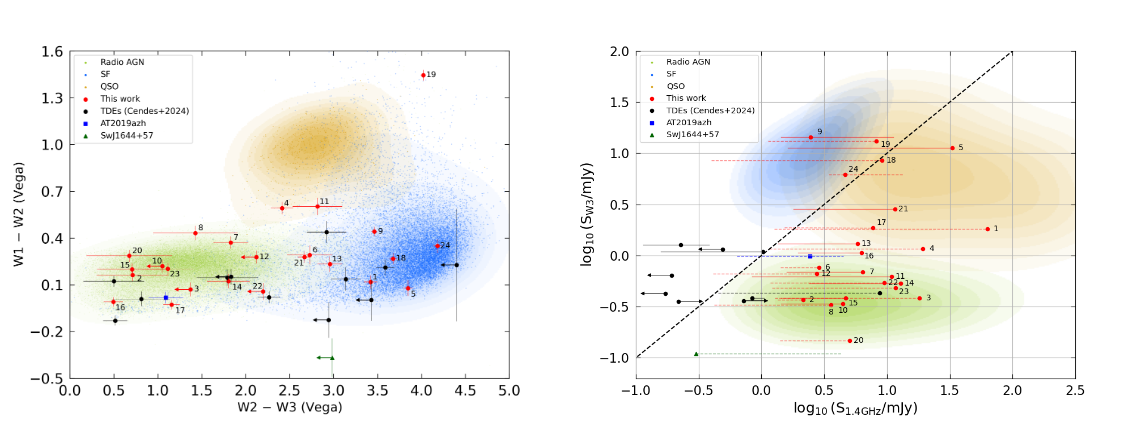
Illustration 2: Left panel: A color-color diagram from WISE for the objects presented in this paper (red dots). Additional points (black dots, blue square, and green triangle) represent TDE events detected in the optical range. The colored density clouds represent the following objects: radio galaxies (green dots), star-forming galaxies (blue), and quasars (yellow). Right panel: A plot of the mid-infrared flux density (W3) versus the radio flux density at 1.4 GHz for the sources presented in the study. The black dots, blue square, and green triangle represent TDEs discovered with optical methods. For clarity, error bars and upper limits are not shown. Solid and dashed lines show the evolution of radio flux density for individual sources, as described in detail in the publication. The main populations of objects are represented solely by the contours of their density distributions: radio galaxies (green), star-forming galaxies (blue), and quasars (yellow). The reference data in both panels are taken from the ROGUE I (Kozieł-Wierzbowska et al. 2021) and ROGUE II (Kozieł-Wierzbowska, in preparation) catalogs. The main dashed line (right panel) defines the relationship SW3 = S1.4 GHz, which allows for the distinction between radio galaxies and star-forming galaxies based on a sample from the ROGUE I catalog (The Authors).
Original publication: M. Kunert-Bajraszewska, D. Kozieł-Wierzbowska, Stern D. et al., Identifying tidal disruption events among radio transient galaxies, Astronomy & Astrophysics, 704, A3 (2025).
The research was conducted at the Department of Stellar and Extragalactic Astronomy of the Jagiellonian University’s Astronomical Observatory of the Jagiellonian University in Kraków. The work was carried out thanks to the financial support of the National Science Center through the grants 2017/26/E/ST9/00216 and 2021/43/B/ST9/03246.
|
Dorota Kozieł-Wierzbowska Astronomical Observatory Jagiellonian University Dorota.Koziel [at] uj.edu.pl |
