

Astronomy Object of the Month: 2026, September
< previous Archive
Emission and structure of jets from the most distant Quasars
Almost every galaxy (with exceptions such as tidal dwarf galaxies) harbors a supermassive black hole at its center. Such a central entity affects the dynamics of stars and dust while feeding on galactic matter through
accretion processes. Add the galactic magnetic field to the equation, and the result is the co-evolution of supermassive black holes and their host galaxies. However, only about 10% of known galaxies are active
galaxies -- those in which the presence of a central engine in the form of a supermassive black hole causes strong non-stellar emission.
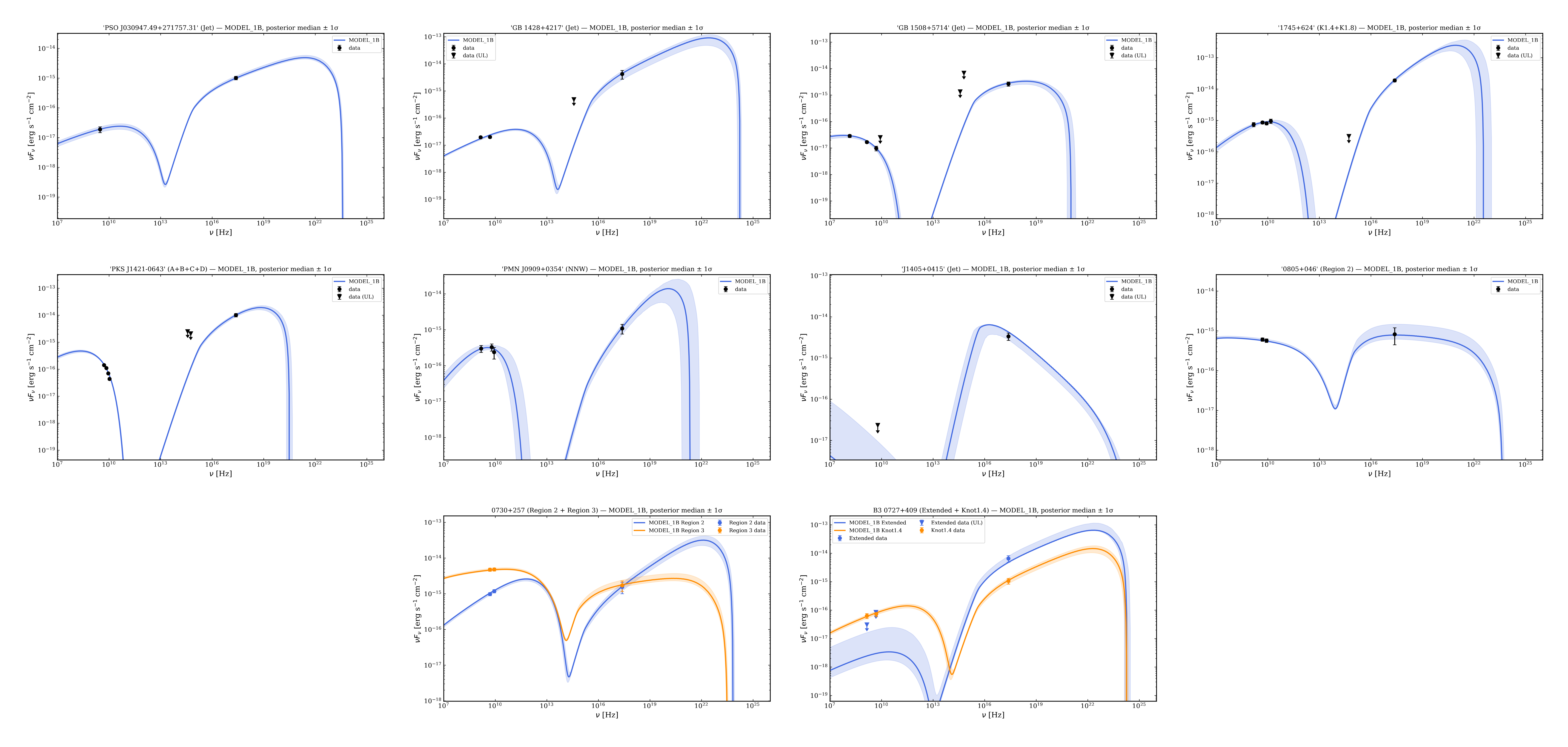
Illustration 1: Broadband spectral energy distributions (SEDs) fitted to a sample of 10 quasars at high redshifts. In each panel: the left hump originates from synchrotron emission produced by the movement of electrically charged, relativistic particles in a magnetic field. The right hump results from inverse Compton scattering of cosmic microwave background photons off the same electron-positron pairs that emit synchrotron radiation. The data points traversed by the left hump represent archival radio fluxes from the VLA interferometer, while those traversed by the right hump correspond to archival X-ray flux measurements from the Chandra Space Telescope. The downward-pointing arrows visible in some panels indicate upper limits on emission, applicable to observations that yielded non-detections. In particular, the downward-pointing arrows between the humps seen in several plots (e.g., for 1745+624 or GB1508+5714) represent archival upper limits on emission from the Hubble Space Telescope. (The Authors)
Among this 10% of active galaxies, only another 10% (meaning 1% of all galaxies) exhibit relativistic jets: extended outflows of plasma and magnetic fields whose emission is observed across almost the entire available electromagnetic spectrum, from long radio waves to energetic gamma rays. In a recent paper in The Astrophysical Journal, we investigated the properties of a sample of the 10 farthest known quasars exhibiting extended jets using data from the VLA interferometer (radio) as well as the Hubble (optical) and Chandra (X-ray) space telescopes.
The core of this work lies in applying a model of large-scale jets (extending over kiloparsecs—tens of thousands of light-years) in magnetohydrostatic equilibrium with a toroidal magnetic field, representing a state where magnetic forces balance plasma pressure gradients perpendicular to the jet axis. A toroidal magnetic field implies that the magnetic field lines form loops in the plane perpendicular to the outflow direction. Furthermore, we assume a cylindrical jet geometry to a good approximation and describe the hot jet fluid using the ultrarelativistic equation of state. Additionally, we consider emission from a relativistic electron-positron plasma. This allows us to parameterize the radial dependencies of the magnetic field induction and the fluid velocity in a very general manner, and thereby reconstruct the internal pressure of the jet in a fully consistent way. Having established a structural model dependent on several parameters, we pose the question: which properties of the jet can be recovered from broadband observations?
Equipped with a magnetohydrodynamic model representing the simplest, physically motivated description of a jet, we compiled a sample of 10 quasars with angularly resolved large-scale jets observed using the VLA radio interferometer in New Mexico and the Chandra X-ray Observatory. The latter, with a spatial resolution below one arcsecond, is particularly suitable for studying such objects. In several cases, we also utilized optical flux upper limits from the well-known Hubble Space Telescope. To the best of our knowledge, this constitutes an essentially complete sample of resolved jets above a redshift of 2.5, with the most distant object studied residing at a redshift of 6.1 -- meaning that the light from this source traveled to us for 12.9 billion years. At these vast distances, corresponding to such an early epoch in the Universe's history, the cosmic microwave background (CMB) was significantly hotter than today and served as the seed photon field for inverse Compton scattering: the prime suspect behind the X-ray emission (although for closer objects, alternative mechanisms have recently been sought!). Conversely, the radio emission originates from synchrotron radiation.
Using advanced statistical methods, Bayesian inference and Monte Carlo algorithms, we rigorously and quantitatively compared four variants of the aforementioned model across different magnetic field configurations, as well as two scenarios where the energy density of the emitting plasma constitutes a constant fraction of either the magnetic field energy density or the gas pressure. It turned out that the topology of the magnetic field is weakly constrained by broadband observations; however, normalizing the emitting particles to the gas pressure is statistically strongly favored. This is a key finding, as such a normalization is typically an assumption in modeling these objects, whereas in principle, the emitting plasma could reside separately from the bulk matter.
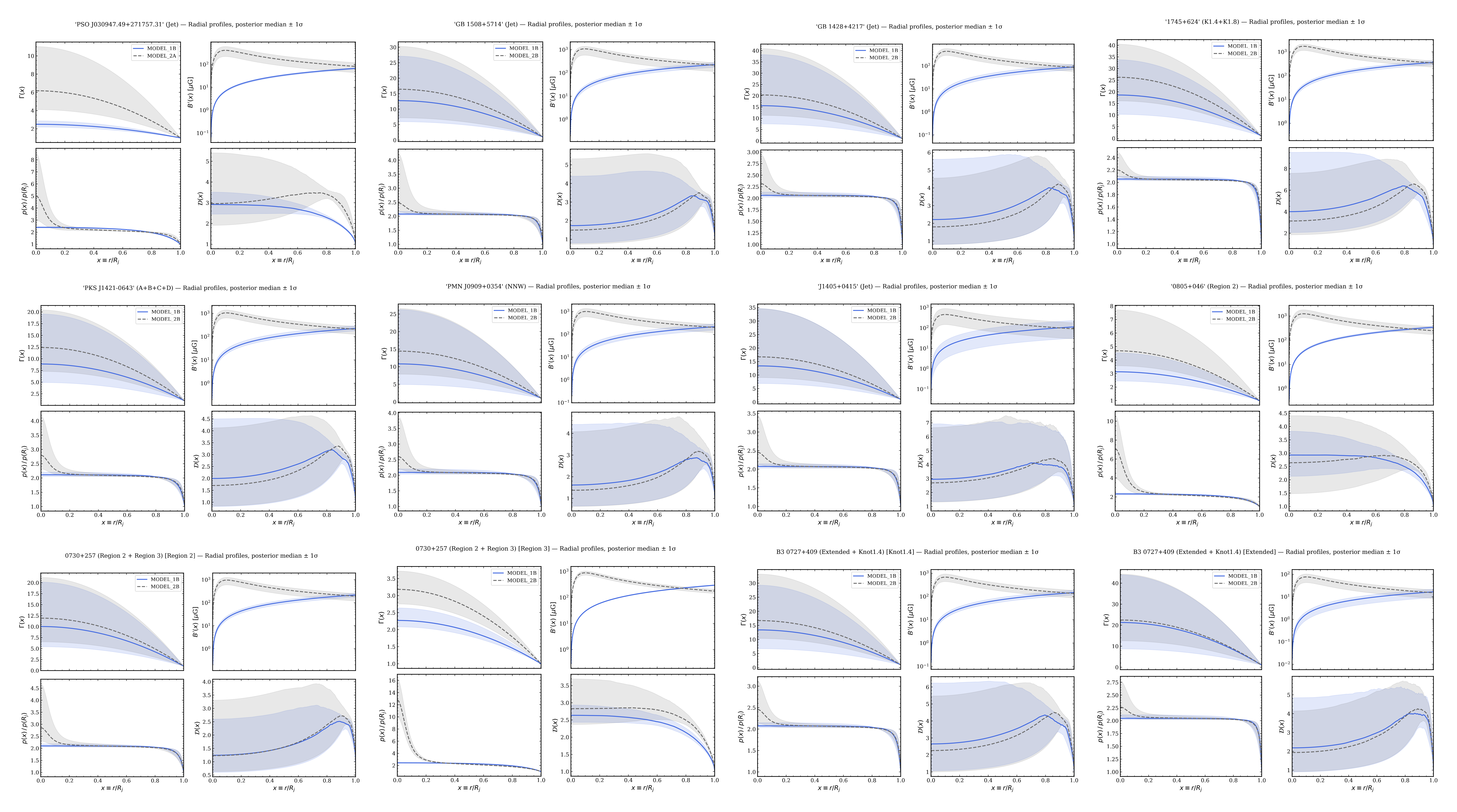
Illustration 2: Radial profiles of jet fluid velocity (expressed via the Lorentz factor), magnetic field, internal jet pressure, and the Doppler factor -- a kinematic quantity related to velocity and viewing angle responsible for relativistic transformations of physical quantities. Each panel displays the two statistically best-fitting models for a given jet or jet segment (blue and gray lines) alongside their uncertainties, indicated by the blue and gray shaded regions. Substantial uncertainty is evident particularly along the jet axis (towards the left side of each plot). Radio polarimetric data -- measuring radio wave polarization in addition to flux - -may prove especially useful in resolving these ambiguities. (The Authors)
For this sample, we determined viewing angles, jet-axis velocities, and magnetization, which indicates whether the jet dynamics are dominated by matter-related effects such as pressure and inertia (magnetization less than unity) or by the magnetic field (magnetization greater than unity). Consistently, every analyzed jet displayed low magnetization (much less than unity), high fluid velocities along the axis, and viewing angles on the order of a dozen degrees. Interestingly, cases yielding lower velocities, higher magnetizations (reaching up to 0.1), or larger viewing angles were fully consistent with the physical picture of the respective source: suspected contamination of the emission by a hot spot contribution in quasar 0730+257 (region 3), or intermediate morphologies in objects 0730+257 and 0805+046, classified as lobe-dominated quasars.
Another major result concerns the derived jet powers, which are systematically higher than those obtained using standard modeling approaches (e.g., homogeneous, single emitting sphere models). This implies that the central engines fuelling these jets must be correspondingly more massive, reaching billions of solar masses in this sample (though this remains nuanced by factors such as the exact jet production mechanism or the assumed equipartition). For objects existing in the young Universe, this raises the fundamental question: how did they grow so massive so quickly? Were such huge masses common, or are we observing only the most extreme tail of the population? Our research group is actively pursuing further studies to answer these questions.
Original publication: P. Liniewicz, Ł. Stawarz, C.C. Cheung, G. Migliori, A. Siemiginowska, Broadband Spectral Modeling of Large-Scale X-Ray Jets in High-redshift Quasars: An MHD-informed Approach, The Astrophysical Journal, 1007, 2 (2026).
The research was conducted at the Department of High Energy Astrophysics of the Jagiellonian University’s Astronomical Observatory of the Jagiellonian University in Kraków. This study was funded by the "Research Support Module" under the "Initiative of Excellence - Research University" program at Jagiellonian University.
|
Patryk Liniewicz Astronomical Observatory Jagiellonian University Patryk.Liniewicz [at] doctoral.uj.edu.pl |
