

Astronomy Object of the Month: 2026, October
< previous Archive next >
The Jagiellonian Field
The Jagiellonian Field is a small region of the sky that has played an important role in the study of the large-scale structure of the Universe, becoming a cornerstone of the modern observational cosmology.
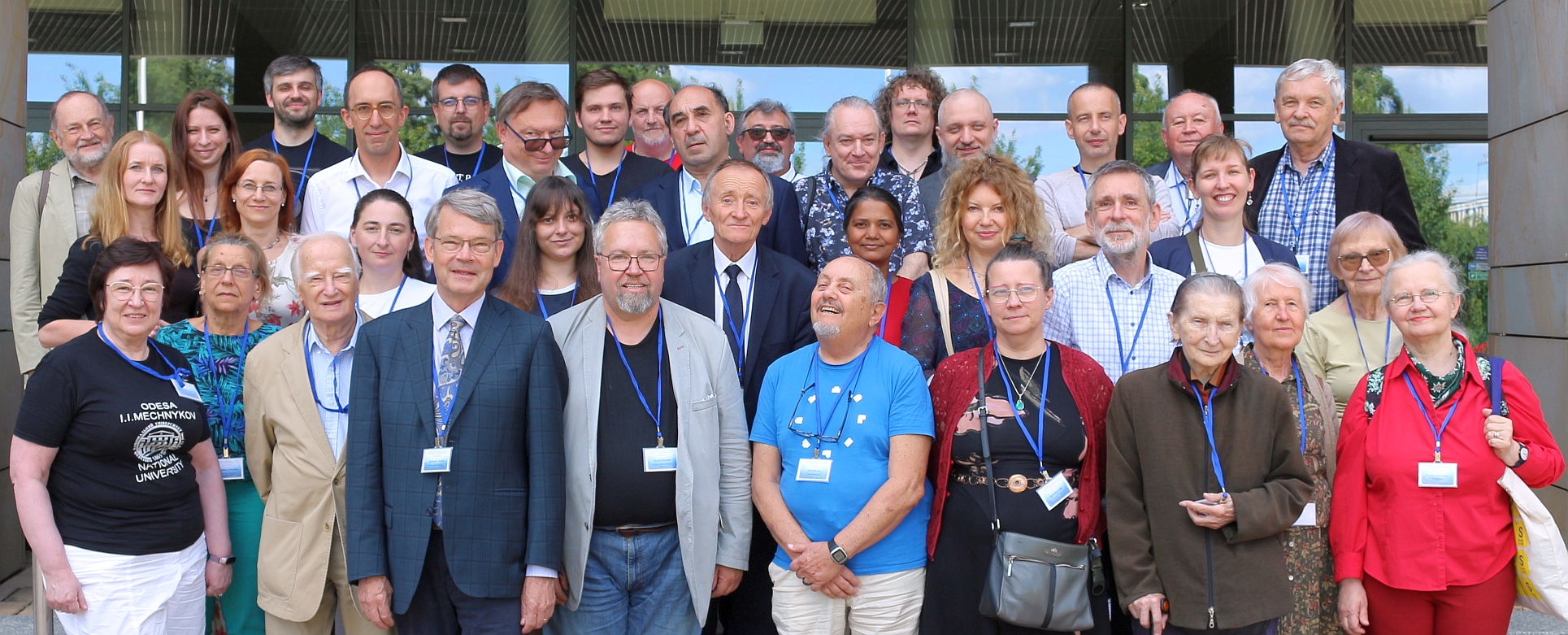
Illustration 1: Participants in the conference “From Astronomical Observations toward Cosmology and the Philosophy of Nature. In Memory of Konrad Rudnicki on the 100th Anniversary of His Birth," dedicated to the 100th anniversary of Professor Konrad Rudnicki’s birth, his life, career, and cosmology research, in the Faculty of Physics, Astronomy, and Applied Computer Science at the Jagiellonian University in Kraków (Bogdan Wszołek).
Its history dates back to the 1960s, when Konrad Rudnicki, the astronomer from Kraków, during his stay in California, became interested in a region of the sky identified by the eminent astrophysicist Fritz Zwicky, situated near the Great Bear, rich in galaxy clusters, but largely free of stars, nearby objects and light-obscuring interstellar dust.
A Schmidt telescope at the Palomar Observatory in California was used to observe this area. Thousands of distant galaxies were recorded on photographic plates. In 1973, the paper *A Catalogue of 15,650 Galaxies in the Jagellonian Field* was published, a catalog comprising 15,650 galaxies. At the time, it was a groundbreaking publication that enabled a shift from observing individual objects to a statistical study of their distribution.
Why is this so significant? Galaxies are not distributed randomly throughout the Universe. Under the influence of gravity, they form groups, clusters, and larger structures, with regions of considerably lower matter density located between them. By analyzing the positions of galaxies, we can reconstruct the history of the formation of these structures and the entire evolution of cosmos.
Over time, the Jagiellonian Field has also been used in various subsequent studies, including analyses of the inhomogeneity of matter distribution on the largest scales. It provided important research material for studies on galaxy clustering. To this day, it demonstrates that even a small patch of sky can yield valuable information about the Universe.
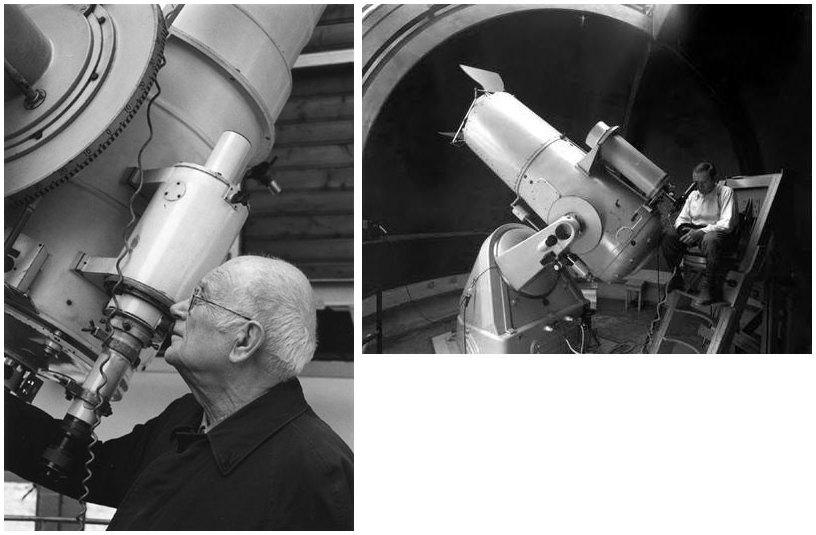
Illustration 2: Left: Prof. Konrad Rudnicki by the Maksutov telescope at the Astronomical Observatory of the Jagiellonian University in Kraków (Bogdan Wszołek); right: Fritz Zwicky and the 1.25-meter Schmidt telescope at the Palomar Observatory (Caltech).
Original publication: Rudnicki, K., Dworak, T. Z., Flin, P., Baranowski, B., Sendrakowski, A., A Catalogue of 15650 Galaxies in the Jagellonian Field, Acta Cosmologica, zeszyt 1, Zeszyty Naukowe Uniwersytetu Jagiellońskiego, 309, 1–164 (1973).
The research was conducted at the Astronomical Observatory of the Jagiellonian University in Kraków.
|
Elżbieta Kuligowska Astronomical Observatory Jagiellonian University E.Kuligowska [at] oa.uj.edu.pl |
