

Astronomy Object of the Month: 2026, March
< previous Archive next >
Can empty space store energy? The influence of standing gravitational waves on the shape of space-time.
Einstein's General Theory of Relativity has predicted the existence of gravitational waves for over a hundred years. However, their nonlinear nature still poses a problem for theorists today. One of the interesting theoretical questions in the theory of gravity is how the presence of gravitational waves affects the shape of spacetime itself.
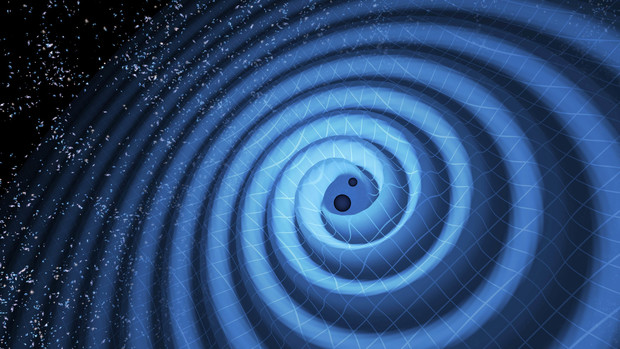
Illustration (1): Visualization of the merger of two black holes and the resulting gravitational waves (LIGO/T. Pyle).
In 1915, Albert Einstein published his General Theory of Relativity. This theory fundamentally changed our perception of the space we inhabit, which was no longer merely a backdrop, or a stage on which physical processes evolved over time. Space-time became the subject of theory, warped according to the complex rigor imposed by Einstein's equations. Thanks to the later work of Einstein himself and subsequent generations of theorists, it was possible to predict completely new phenomena within the framework of the new theory, such as the existence of gravitational waves. The final, direct proof of their presence has been recorded almost exactly 100 years after the General Theory of Relativity was developed, on September 14, 2015, with the help of the LIGO interferometer.
Gravitational waves are not waves transmitted by any medium. They do not describe vibrations of matter, such as waves on water, or sound, which are vibrations of air. It is space-time itself that ripples—it stretches and compresses periodically, repeatedly increasing and decreasing the distances between nearby objects within its sphere of influence. The effects measured on Earth are microscopic: the length of the arms of the LIGO interferometer, used to detect such waves, which is 4 km, was changed by only 4*10-18 m. This distance is several hundred times smaller than the diameter of a proton, yet it was detected and measured by the detector. This highlights the incredible precision of the instrument and the scale of the achievement of the researchers involved in the project.
Various wave phenomena have been studied by physicists for hundreds of years, but the fundamental difficulty in describing gravitational waves lies in their nonlinear nature. The nonlinearity of Einstein's equations means that, unlike electromagnetism or mechanical waves, directly adding two known solutions to Einstein's equations describing gravitational waves does not usually provide a mathematically correct description of the system of superimposed waves. It is precisely these nonlinear effects, requiring the examination of complete unique solutions to Einstein's equations, that are the subject of theoretical research conducted at the Department of Relativistic Astrophysics and Cosmology of the Jagiellonian University Astronomical Observatory. One such nonlinear effect is the so-called backreaction. In the 1950s, Andrzej Trautman showed that gravitational waves transfer energy. This means that, according to Einstein's idea, they affect the curvature of spacetime, changing its shape. From this perspective, the spacetime of Halilsoy and Chandrasekhar, containing standing gravitational waves, was analyzed. A standing wave is one that does not move but oscillates while remaining in the same place, like a vibrating guitar string.
The exact wave solutions of Einstein's equations describe vacuum spacetime, not filled with any kind of matter or radiation. However, the averaged, effective influence of gravitational waves may resemble a simpler spacetime, but one filled with additional matter. The Green-Wald formalism is used here, a mathematical procedure that allows the averaged, effective influence of the presence of a wave on the shape of the entire spacetime to be described. The team studied the behavior of waves in the so-called high-frequency limit, which allows for a better understanding of the averaged, effective impact of the wave. In the case of the waves studied, vacuum spacetime with standing gravitational waves after such averaging “simulates” the presence of matter, and their effective contribution looks like so-called zero dust. This is a term used to describe matter consisting of particles moving at the speed of light, such as a stream of massless neutrinos or photons.
The significance of the backreaction problem extends beyond gravitational wave theory and may also apply to systems filled with matter. The issue is particularly important in cosmology. The commonly used Friedman-Lemaître-Robertson-Walker (FLRW) cosmological model is successful in describing many aspects of the Universe, but it is a highly idealized model, assuming a homogeneous distribution of matter at every point and in every direction. The Universe we interact with on a daily basis does not look like this. We observe the existence of distinctly inhomogeneous planets, stars, galaxies, and their clusters, interspersed with vast voids of space (schematically shown in the illustration). And the Green-Wald formalism provides tools for describing and studying the properties of the influence of such small-scale (compared to the scale of the entire Universe) inhomogeneities.
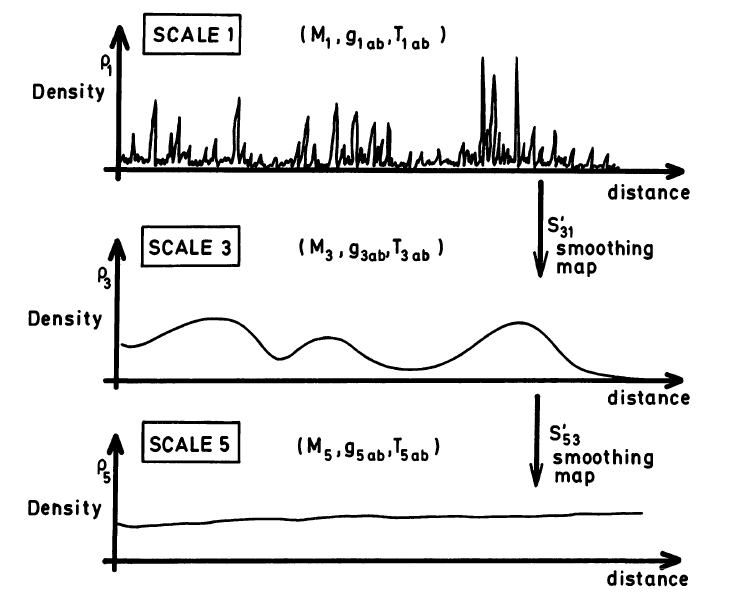
Illustration (2): Scales of inhomogeneity in the Universe. The real Universe is mostly filled with emptiness, interrupted by compact massive objects such as planets, stars, and galactic nuclei (first image). Smaller objects commonly combine into gravitationally bound systems: galaxies, groups and clusters of galaxies, i.e., large-scale structures whose evolution can be considered as a whole (middle image). Cosmological models such as FLRW assume a very smooth, homogeneous distribution of matter throughout the Universe, averaging out the actual distribution of matter. (“How well is our Universe described by an FLRW model?” (Green, S. R. Wald, R. M., 2011, Physical Review D, 83, 084020)).
Original publication: Sebastian J. Szybka, Adam A. Zychowicz, Dominika Hunik, Backreaction of Halilsoy and Chandrasekhar waves (2026).
The research described is part of the research topics conducted at the Department of Relativistic Astrophysics and Cosmology of the Astronomical Observatory of the Jagiellonian University in Kraków.
|
Adam Zychowicz Astronomical Observatory Jagiellonian University Adam.Zychowicz [at] doctoral.uj.edu.pl |
