

Astronomy Object of the Month: 2026, January
< previous Archive next >
288P: main-belt comet
Comet 288P, which also bears the designation 2006 VW139, typical of asteroids, belongs to a somewhat strange category of small solar system bodies which falls between comets and asteroids. Objects that make up this group are called Main-belt comets or active asteroids hence their often double designations. Like its marking, the object is also double and is formed by a pair of bodies orbiting each other. In addition both fragments rotate.
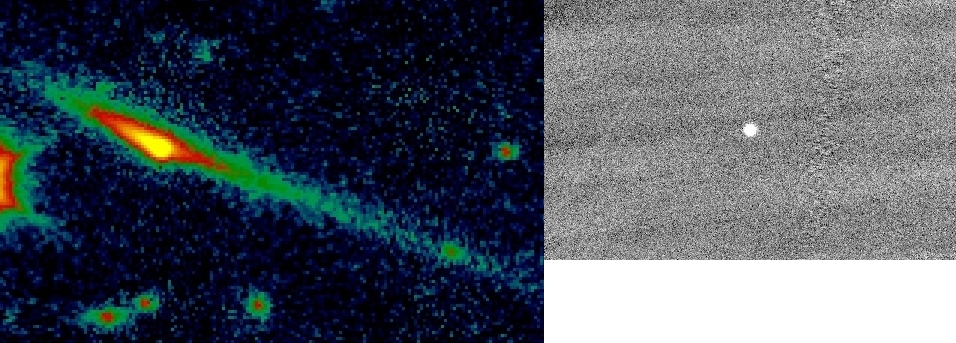
Illustration 1: Images of 288P obtained by the team led by Javier Licandro (Licandro, J., Moreno, F., de León, J, Tozzi, G.P., Lara, M., & Cabrera-Lavers, A. 2013, A&A, 550, A17) with GTC telescope in Spain in 2011 (left panel) and by us in 2015 (right panel). Our image is a composite of 444 individual photos from Keck II and Gemini-South telescopes and has a total exposure time of 7 hours. We used a special procedure of image processing to remove background stars and galaxies.
The team of scientists composed of Wacław Waniak and Michał Drahus from the Astronomical Observatory of the Jagiellonian University observed this intriguing object using two large telescopes working in tandem: Keck II in Hawaii and Gemini-South in Chile. Thanks to the obtained data an analysis of brightness changes over time was carried out. This allowed us to better characterize 288P. Most importantly, we could analyze its evolution scenario starting from the division of a bilobate (object with necking or two lumps connected by a neck) parent body to the current state where one fragment rotates slowly, the other quickly and both orbit each other at a record distance.
Main-belt comets have the characteristic of both asteroids, revolving the Sun generally between the orbits of Mars and Jupiter, and comets, as they display protracted and recurrent activity. They release matter creating dust shell called coma or tail, typical hallmark of comet. Time to time they present unexpected and spectacular disruption events like e.g. P/2010 A2 (LINEAR) or P/2013 R3. But the current interest in studying active asteroids does not lie in their strangeness but in their role as objects responsible for the primordial delivering of terrestrial water
We know hundreds of double objects among typical asteroids and most probably double asteroids are quite frequent, but 288P is the only known double Main-belt comet. From HST observations made by the team of scientists led by Jesica Agarwal (Agarwal, J., Jewitt, Mutchler, M., Weaver, H., & Larson, S. 2017, Nature, 549, 357) we know the mean distance between both components, which is a bit over 100 km and is record-breaking compared to the sizes of fragments themselves, which are of the order of a few kilometres. On the other hand, 288P, like a typical active asteroid, releases matter when passing through the orbit region closest to the Sun and extinguishes emission activity while being far away from our star. Illustration 1 presents images of this object in these two different situations.
The photo we received (right panel) shows a boring appearance of 288P with no trace of coma or tail that are visible in the left panel, but due to the lack of these features we could measure the pure brightness of the comet, unaffected by their light. This allowed us to analyze how this brightness changed over time. Such changes, if they are periodic, are the result of rotation of the non-spherical body shining with reflected light, when the size of the reflecting surface seen by the observer changes due to the spinning. Unfortunately, in the case of 288P we are dealing with a superposition of changes coming from both its fragments because one hundred kilometers distance between components is too small compared to the hundreds of millions of kilometers distance between the Earth and 288P to see the fragments completely separated. Thanks to a special approach involving knowledge of the reflective properties of asteroid surface we were able to separate these superimposed brightness variations (Illustration 2). We could determine periods of rotation for both components of 288P which appeared to be 15.9 h and 3.4 h for greater and smaller fragment respectively. The most probable shape of both bodies is prolonged spheroid (something like a cucumber) which rotates around an axis perpendicular to the direction of extension. The sizes of the components are 2.2x1.4x1.4 km and 1.3x1.2x1.2 km, which indicates that the larger body is much more elongated that the smaller one.
After analysing the current physical state of 288P and the possible genesis of its doubleness we outlined a coherent scenario of its evolution, which most probably started from the disintegration of the bilobate parent body into two fragments. The cause of the breakdown lies in critically fast rotation when centrifugal force overcomes gravity and cohesive forces that hold two lobes together. Such an increase of the rotational velocity could have been the result of the recoil effect associated with a properly directed outflow of matter from the comet. We estimated this critical rotation period that appeared to be between 3 and 8 hours depending on the model assumptions made. The cause of a significant slowdown in the rotation of the larger fragment to today’s 16 h period is the tidal interaction between components (as in the case of Earth’s oceans), which reduces the energy of rotation through deformations of the bodies. Certainly the smaller fragment should have slowed down its rotation much more than the larger one or been tidally locked (like our Moon which rotates at the same rate as it orbits the Earth). Assuming this smaller body is emitting gas and dust, the recoil effect could disturb the tidal interaction and this could lead to its ralatively rapid rotation, currently observed, as well as to a significant increase in the mean distance between the components of 288P.
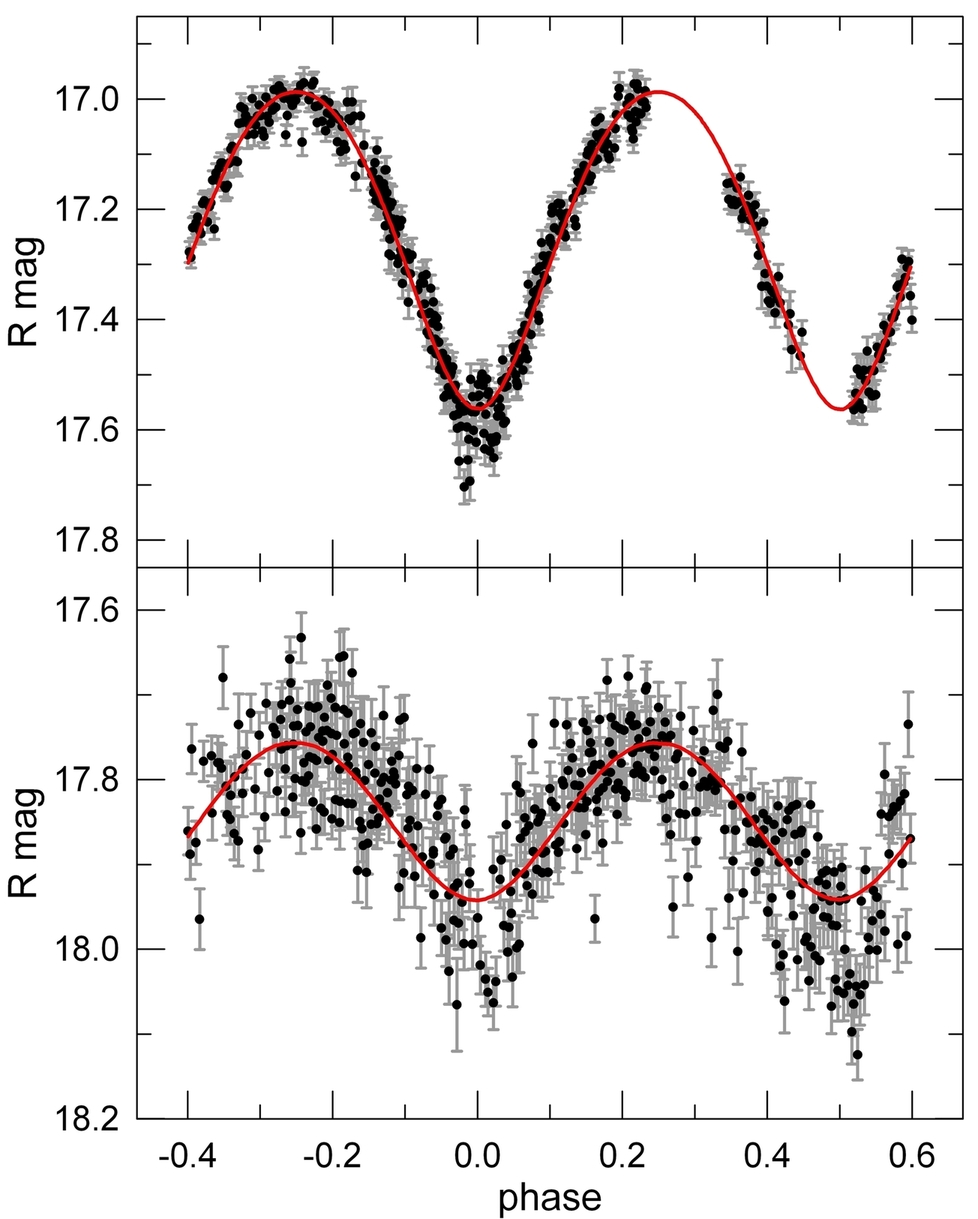
Illustration 2: Result of separation of the brightness variability of 288P into two variations produced by the larger, slowly rotating component (top panel) and smaller, rapidly spinning fragment (bottom panel). The model brightness variations that are in the best agreement with the observed ones are shown by red lines. Both brightness variations are expressed in R band magnitudes (logarithmic scale) and presented as functions of rotation phase (from 0 to 1.0, where the last value means full rotation period). (The Authors). `
Original publication: Waniak, W., Drahus, M., Component-resolved light curve of the binary main-belt comet 288P/2006 VW139s, Astron. Astrophys. 704, A169 (2025).
The research described is part of the research topics conducted at the Department of Stellar and Extragalactic Astronomy of the Astronomical Observatory of the Jagiellonian University in Kraków.
|
Wacław Waniak Astronomical Observatory Jagiellonian University W.Waniak [at] oa.uj.edu.pl |
