

Astronomy Object of the Month: 2026, May
< previous Archive next >
OAUJ-CDK500: A new robotic telescope in Cracow
We provide details of the OAUJ-CDK500, the newest optical telescope at the Astronomical Observatory of the Jagiellonian University,
and the hardware and software which enables it to work autonomously as a telescope within the Skynet Robotic Telescope Network.
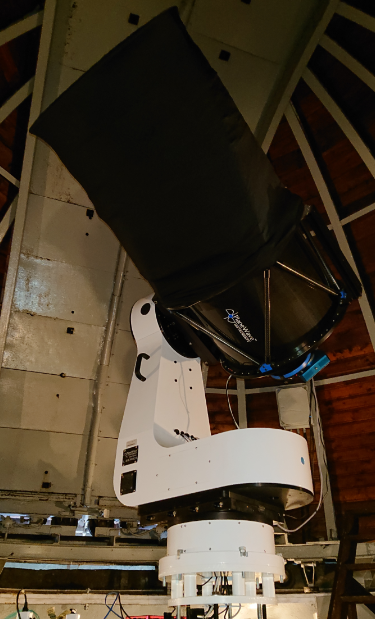
Illustration 1: The OAUJ-CDK500 telescope inside the Zeiss dome (The Authors).
Until nearly the end of the 20th century, observations with ground-based optical telescopes required the presence of an on-site observer, who decided if the weather conditions were suitable and had to manually open the dome and operate the instrument. Subsequent progress in computing power and networking made remote observing possible, but typically required continuous monitoring by the human observer and a night assistant to be present on-site. Then, decreasing costs and improving capabilities of computers, sensors and microcontrollers around the 1990s led to the development of hardware and software capable of autonomously executing observations from predefined target list. The first individual robotic telescopes were soon followed by the creation of robotic telescope networks, eventually spanning multiple continents. Examples include the Bootes network (1998), and the Skynet Robotic Telescope Network (2004).
Until 2019, the Astronomical Observatory of the Jagiellonian University in Cracow had three optical telescopes, all of which were manually operated. The decision was made to purchase a modern 50 cm telescope which could be used both for automated scientific observations and for teaching. The new PlaneWave telescope arrived at the end of 2019 and fully commissioned in early 2020, is a 50.8 cm diameter f/6.8 Corrected Dall-Kirkham (CDK). The CDK optical design consists of an ellipsoidal primary mirror, a spherical secondary and additional lenses to correct off-axis aberrations. The telescope works on the PlaneWave L-500 direct-drive mount, ensuring high pointing precision and fast slewing speeds up to 50◦ per second. The alt-azimuth type mount necessitates a field derotator, here integrated with the focuser. OAUJ-CDK500 has been installed in the 6-meter Zeiss dome formerly housing an astrograph, automated with a Technical Innovations Digital Dome Works (DDW) system. The telescope operates in the Skynet Robotic Telescope Network.
Two crucial pieces of hardware must be present for a fully autonomous telescope to operate safely and be aware of changing weather conditions: a cloud sensor and a weather station providing rainfall, wind, temperature and humidity measurements. Our observatory is equipped with the AAG cloud sensor and a Davis WeatherPro station which provide continuous monitoring of weather status at the site. Current weather conditions and the dome position can be visually checked with a SBIG Allsky-340C camera mounted next to the dome. To enable fully autonomous and unsupervised operation, we use weather monitoring software to retrieve information from the sensors, and its central part is WeatherMan, a custom weather data collection service created by the Skynet team. The weather data is analyzed to determine if the conditions are safe to keep the dome open, and failure to retrieve data from a particular sensor is also considered an unsafe situation.
The Skynet Robotic Telescope Network consists of two parts: the server side, hosted at the University of North Carolina, USA, and software running on a data gathering computer at each site. The server is responsible for submission of observation requests, their prioritization and scheduling, and dispatch to one or more telescopes for execution. After the observations, the client computers transfer images to the server for calibration. Once calibration is completed, the images are ready for download by the user.
From the users’ perspective, observations within the Skynet network are submitted via a web-based interface. This is suitable for users with all levels of experience, from school students to professionals. The interface allows for target objects to be chosen via map, name search or by directly entering coordinates. Selected filters can be set for each exposure. The interface can be easily used to set up observations ranging from ’pretty sky pictures’ to carefully-planned long-duration photometric studies. Once submitted the process is fully automated. The Skynet server will allocate time on the particular telescope (or a subset of telescopes) until the list of desired targets is completed. Skynet users do not have to take bias, dark and flatfield calibration images themselves, as this task is also automatically scheduled by the Skynet server and image calibration is performed automatically.
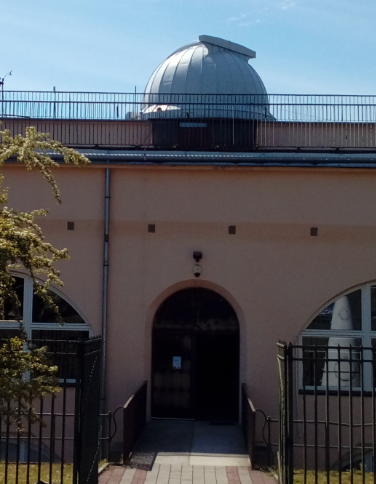
Illustration 2: The dome of the OAUJ-CDK500 telescope (The Authors).
Since its installation at the beginning of 2020, the telescope has collected several thousand images. Its scientific programs mostly consisted of long term monitoring of extragalactic targets, as these are most suitable for unpredictable weather conditions. The OAUJ CDK500 operating within the Skynet network has already proven itself to be a reliable and efficient tool supporting the scientific, educational and outreach missions of the Jagiellonian University Astronomical Observatory.
Original publication: Zoła, S., Stachowski, G., Kurowski, S., Kundera, T., Waniak, W. et al., OAUJ-CDK500: A New Kraków Robotic Telescope, VII Workshop on Robotic Autonomous Observatories, Revista Mexicana de Astronomía y Astrofísica (Serie de Conferencias), 59, 31 (2025).
The research described is part of the research topics conducted at the Department of Stellar and Extragalactic Astronomy of the Astronomical Observatory of the Jagiellonian University in Kraków. This project used data obtained via BHTOM (https://bhtom.space [bh-tom.space]), which has received funding from the European Union’s Horizon 2020 research and innovation program under grant agreements No. 730890 (OPTICON) and 101004719 (OPTICON-RadioNETPilot). Funding for the OAUJ-CDK500 telescope was provided by the Jagiellonian University.
|
Grzegorz Stachowski Astronomical Observatory Jagiellonian University Grzegorz.Stachowski [at] oa.uj.edu.pl |
